Imagine knowing exactly when a target account is researching your specific solution, comparing your pricing features, or reading up on your direct competitors, before they ever fill out a form on your website.
Sounds like a mind-reading trick, right?
But here is the reality check: most B2B marketing and sales teams are still playing a guessing game. They pull a static list of 10,000 companies based on basic size or location, and they treat every single one of them exactly the same. They send the same cold emails, run the same generic ads, and wonder why conversion rates are completely flat line.
They are operating under the dangerous assumption that more pipeline equals more revenue. It doesn't. Better pipeline equals more revenue. Building a 5X low-grade pipeline full of low-intent accounts is actually worse than building a 1X highly qualified pipeline. If your sales organization cannot confidently defend its pipeline, you simply cannot forecast your future.
In 2026, the game has fundamentally changed. Studies show that over two-thirds of the B2B buying journey happens digitally before a prospect ever speaks to a sales representative. They are reading blogs, looking at review sites, and querying conversational AI engines. If you are waiting around for a prospect to click that "Contact Us" button, you are already too late.
That is the exact gap B2B intent data is built to fix. It tells us who is actively in the market right now, so we don't waste time on accounts that have zero interest. Let’s break down exactly how it works, why traditional setups fail, and how we can use it to build an unstoppable pipeline.
Let’s keep it simple. B2B intent data is the digital body language of an organization.
When an individual at a company starts feeling an operational pain point, they don't buy software immediately. First, they research. They read educational whitepapers, search for specific terms on Google, download guides, and check out software comparison grids.
When multiple stakeholders at the same company start doing this simultaneously, they leave an aggregate digital trail. Intent data captures that trail, aggregates it at the account level, and flags it so your revenue team knows a business is actively trying to solve a problem.
However, we need to establish a critical distinction right here: intent data is a raw input, not a final business decision. Most sales teams treat intent signals as an absolute mandate, a raw list to immediately hand over to busy BDRs. The signals might say "this company is researching topic X," but that raw data fragment fails to tell you whether you should call right now or wait, which specific rep should handle the reach out, what precise strategic angle to use in your outbound copy, or whether this account even fits your core target profile.
To see where this fits into your larger go-to-market strategy, we like to look at data through a simple three-tier framework:
Firmographics: Who they are + Technographics: What they use + Intent Data: Active Timing = The Perfect Target
Not all intent signals are created equal. To build a highly profitable outbound motion, we must categorize signals into three distinct buckets, balancing how accurate they are against how many accounts they can surface.
This is behavioral data collected directly on your owned digital properties. When an anonymous visitor reads your blog posts, stays on your pricing page for five minutes, or reviews your documentation, that is first-party intent.
This data is collected on trusted, independent B2B review ecosystems like G2, TrustRadius, or Gartner Peer Insights.
When a company is seriously considering a purchase, they go to these platforms to read user reviews and compare your tool side-by-side with your competitors. Buying access to these data feeds lets you see exactly which target accounts are looking at your profile or exploring your category alternative pages.
This is data aggregated across thousands of independent B2B publisher networks, media sites, and content syndicates (often powered by data co-operatives like Bombora).
These platforms monitor the baseline reading habits of millions of companies. When a business suddenly consumes a massive amount of content around a specific keyword (way more than their historical average), the system flags a topic surge.
To truly leverage this strategy, we need to understand how these platforms separate real buying signals from random web browsing.
Most enterprise data providers use an algorithmic baseline model. Let's say a major enterprise company normally reads about five articles a week related to "data security." That is their historical baseline.
Suddenly, over a 48-hour period, fifteen different employees at that same company read 80 articles, downloaded three whitepapers, and searched for terms related to "compliance automation encryption."
Historical Baseline: 5 Reads/Week ──> Activity Spike: 80 Reads + Downloads ──> AI Triggers "Intent Surge"
Because the activity has spiked significantly above their standard baseline, the intent engine calculates a high surge score, indicating the business has likely entered an active buying or problem-solving cycle.
We also have to acknowledge that the B2B buying journey has evolved. Today, buyers spend a massive amount of time in private Slack channels, closed communities, dark social, and conversational AI interfaces like Perplexity or ChatGPT.
Because traditional cookie tracking and old-school keyword scraping cannot see inside these closed networks, standard standalone intent feeds are missing a massive piece of the puzzle. To stay ahead, we must connect raw intent signals with deeper contextual learning engines.
We talk to B2B founders and sales leaders every single week who buy incredibly expensive intent data subscriptions, only to cancel them a year later. Why does this happen?
It happens because raw data does not generate a pipeline; execution does.
Traditional data providers dump a massive, messy spreadsheet of "surging accounts" into your CRM system once a week. Marketing operations looks at it, gets overwhelmed, and drops them into a generic email sequence.
Meanwhile, your sales reps completely ignore the data because a list of company names doesn't tell them why the account is interested, how to win the deal, or who they should actually reach out to.
It is a disconnected, highly fragmented system that creates massive internal friction.
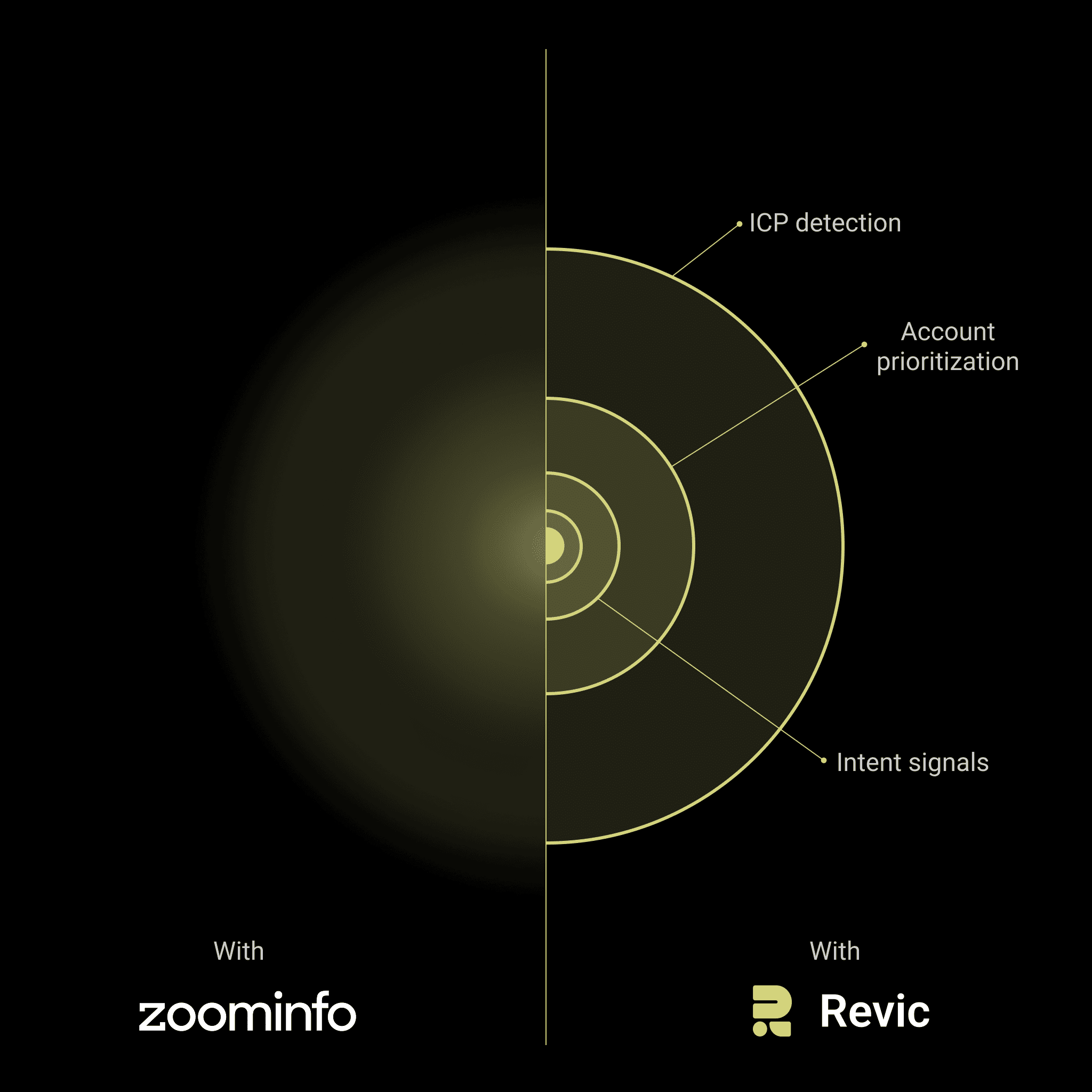
This exact failure is why we built Revic as an AI-native pipeline generation platform. We don't believe intent data should live in a standalone silo.
Instead of forcing you to buy one tool for intent, another for company data, and a third for contact scraping, we unified the entire loop. The modern enterprise market is moving rapidly away from old-school intent platforms toward integrated systems that surface exactly which accounts to prioritize and precisely why, not just flag that an anonymous user clicked on a competitor's digital ad.
Revic approaches intent differently by anchoring it directly to your actual pipeline history. Our system dynamically analyzes your closed-won data to identify the exact, complex combinations of signals that historically predicted a completed purchase. We use those deep learning loops to continuously score and prioritize your outbound pipeline, ensuring your reps aren't just reacting to arbitrary web noise, but are instead responding to highly validated buying indicators.
If you want to prevent your GTM team from getting intent tracking wrong, you must establish clear operational boundaries. Modern revenue operations leaders use a distinct, four-part operational framework to guide their execution:
To successfully convert intent signals into booked product demos, you need a structured, tiered response framework. You cannot treat an early-stage researcher the same way you treat a bottom-of-funnel buyer.
The Golden Rule of Intent: Speed and context always win. If an intent signal sits in your sales pipeline for a week without an automated or human response, the buying window closes, and your competitor wins the deal.
Here is the bottom line: B2B intent data is an incredibly powerful ingredient, but it is not the full meal. Buying standalone data feeds without an automated way to research accounts and find contacts just creates an expensive, disjointed software stack that slows your team down.
We are seeing that the fastest-growing revenue teams of tomorrow are completely consolidating their GTM technology. They are moving away from fragmented databases and adopting integrated, AI-native pipeline generation platforms that seamlessly turn real-time digital signals into automated, high-converting outbound execution loops.
Let's stop guessing who is ready to buy. Let's let AI replicate your absolute best sales plays the exact moment a buyer shows their hand.
Stop paying for noisy, disconnected data feeds that your sales reps ignore. It's time to bridge the gap between intent signal and revenue execution.
Ready to see how we seamlessly turn real-time intent data into high-converting outbound pipelines? Schedule your live demo with Revic today and accelerate your revenue engine.
.jpeg)