If you look closely at the daily activity of the average B2B sales team, you will witness a massive amount of wasted energy.
Every single morning, your SDRs log into their dashboards and start hammering dials, sending emails, and blasting LinkedIn messages. They are chasing any lead that fits a basic corporate profile. They pour hours into prospects that look promising on paper but have absolutely zero chance of ever buying from you.
The numbers tell a painful story. Across the B2B landscape, the average lead-to-customer conversion rate hovers between a dismal 1.5% and 3%. That means a staggering 97% to 98% of your marketing and sales efforts are going completely down the drain.
Why does this happen? It’s simple: teams are targeting companies based on who they are, rather than what they need.
We see sales leaders make the same fundamental mistake year after year. They run an annual workshop, look at their best clients, and declare: "Our ICP is mid-market SaaS companies with 100 to 500 employees in North America."
That isn't an Ideal Customer Profile. That is a comfort zone.
If we want to build a highly predictable, hyper-efficient revenue engine, we have to stop using static corporate filters. We need to move beyond standard firmographics and transition to a dynamic model built on shared patterns of pain.
What is ICP in sales? In traditional B2B sales textbooks, ICP stands for Ideal Customer Profile. It is typically defined as a static description of the perfect target organization based on surface-level, easily searchable attributes.
When a standard RevOps team sets out to build a profile, they pull a historical report from their customer relationship management (CRM) platform and look exclusively at three core data pillars:
[Traditional ICP Filter] ──> Industry + Headcount + Revenue ──> Bloated, Low-Conversion Lists
Once these numbers are documented in a static PDF, the marketing team buys a massive database list matching those exact filters and dumps it into the sales pipeline.
This is exactly how most companies define their target market. It is clean, it is easy to filter in a data broker, and it makes complete sense on a spreadsheet. Unfortunately, it is also fundamentally wrong.
When you rely strictly on firmographic attributes to build your target list, you create an execution gap. Your outbound reps carefully apply the spreadsheet filters, pull a list of matching accounts, and still end up working the wrong accounts.
Why? Because firmographics tell you who a company is, but they say absolutely nothing about whether that company wants to buy software today.
Within that broad bucket of "mid-market SaaS companies with 200 employees," you will find massive structural and behavioral differences:
If your SDRs treat Company A and Company B exactly the same because they share the same firmographic data, your conversion rates will plummet. Traditional profiles create a false sense of accuracy while delivering bloated target lists filled with accounts that will never convert.
We need to treat traditional target profiling as a legacy construct. What we are ultimately trying to accomplish when we build an Ideal Customer Profile is not to find companies that look the same on paper, but to identify cohorts of businesses that exhibit the specific operational friction our product solves.
The Reality Check: The right customers don’t share firmographics, they share patterns of pain. Companies that buy from us don't look the same; they struggle the same.
When you shift your perspective from attributes to problems, your entire go-to-market architecture transforms. Your target list shrinks in volume, but skyrockets in conversion probability.
[Modern Behavioral ICP] ──> Shared Internal Friction ──> High-Intent Target List ──> Scaled Demos
An enterprise could be an early-stage startup with 20 employees or a legacy institution with 5,000 workers. If they are both losing $50,000 a month due to a specific administrative data silo, they both belong in your target model. Their shared pain pattern makes them highly qualified, regardless of their differences in headcount or funding status.
To transition away from comfortable spreadsheets and build a highly accurate behavioral model, we must layer real-world digital indicators together. We look for specific intent-related signals and behavioral triggers that point directly to internal operational friction.
Instead of running a manual brainstorming session to guess what your customers care about, you need to track these deep behavioral indicators across four core pillars:
Look beyond what software an account uses. Track how they are utilizing their technology stack. Are they struggling with compatibility? Are they actively looking to replace a legacy system that requires constant engineering maintenance?
A company's job board is a direct window into their operational vulnerabilities. If a target account is suddenly trying to hire ten manual data entry specialists, they are experiencing an operational scaling bottleneck. That job listing is a clear behavioral signal that they need automation software.
Move away from basic intent signal platforms that merely tell you "Someone at IBM clicked an ad." You need deep, multi-stakeholder tracking. Look for patterns where an economic buyer, a technical reviewer, and an end-user are all simultaneously reading technical case studies, downloading API docs, or calculating ROI on your site.
When a new executive enters an organization, they are almost always hired to change a broken process or hit an aggressive growth target. This operational shift opens a prime buying window for your solutions.
The core reason traditional profiles fail over time is that they are treated as static, historical snapshots. A group of managers documents them during a planning session, applies them to their data filters, and never revisits them.
But markets change, products evolve, and customer problems shift daily.
This is exactly why we must move toward an AI-driven learning engine. Instead of treating your target profile as a rigid PDF file, modern revenue organizations are using AI agents to turn target discovery into a continuous, real-time feedback loop.
By leveraging an AI-native architecture, your customer target model self-corrects automatically. The system monitors every single closed-won deal, analyzes real-world sales transcripts, and maps the exact behavioral indicators that preceded a successful sale.
If a new cohort of companies suddenly exhibits the exact pain pattern your product solves, the AI immediately flags them and pulls them into your outbound queue, even if they look completely different from your historical customers on paper.
Here is the bottom line: defining your B2B ideal customer profile by industry and company size is an outdated approach. It forces your sales team to waste hours chasing low-probability accounts that happen to match a comfortable spreadsheet filter but have zero operational need for your tool.
To scale your pipeline efficiently, you need to stop targeting who a company is and start targeting what they need. You need a system that doesn't just define a static profile on paper, but actively uses real-time behavioral signals to automate your pipeline generation.
We built Revic to completely eliminate guesswork from your go-to-market motion.
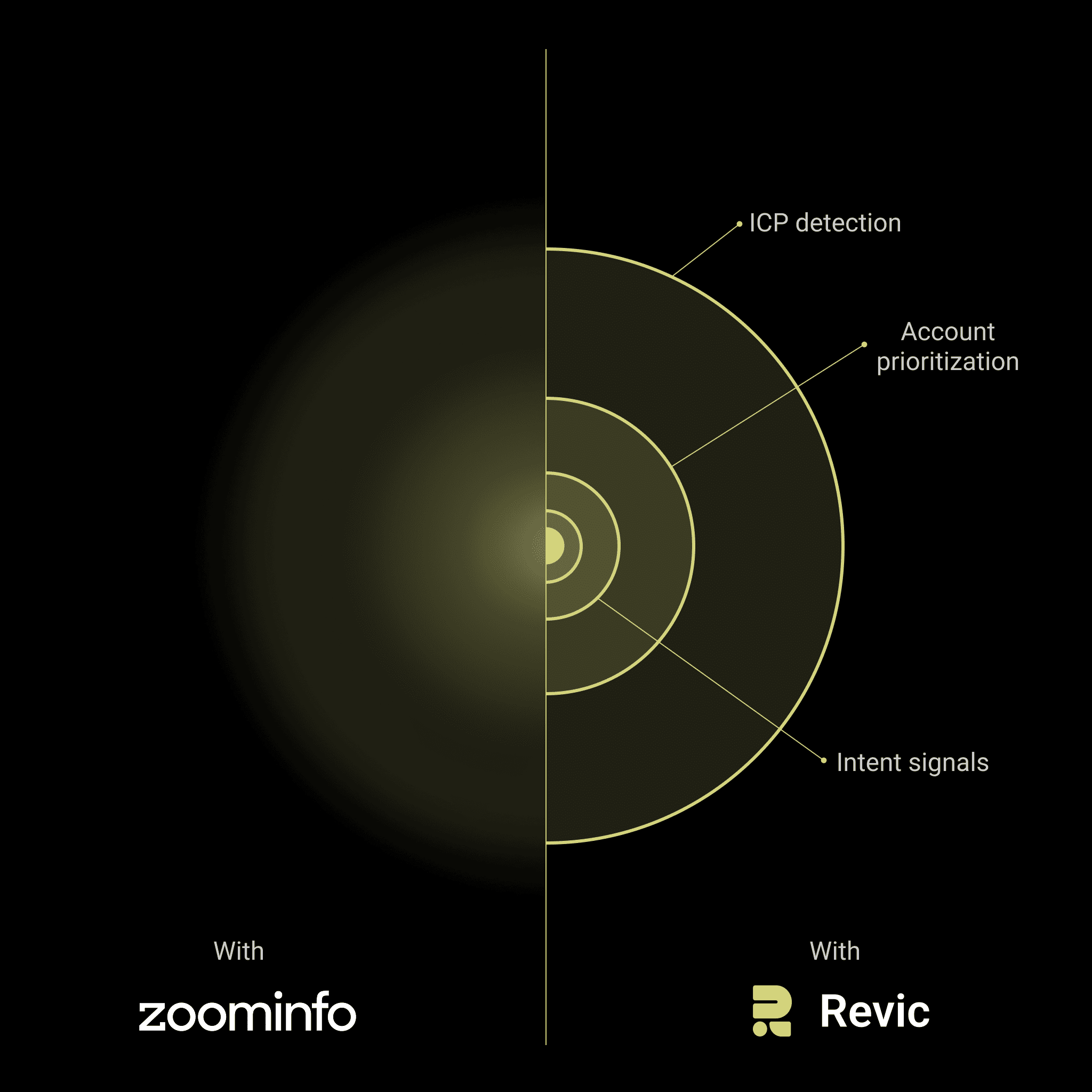
Instead of forcing your operations team to buy bloated, low-conversion lead databases, Revic’s AI-native pipeline platform continuously analyzes your live win/loss data to automatically detect your true, underlying pain-pattern profiles. It identifies the high-probability accounts, prioritizes your queue based on actual need, handles deep contextual account research, maps out the internal buying committee, and hands your reps an actionable pipeline ready for targeted outreach.
Stop targeting based on who they are. Start targeting what they need.
Ready to transform your outbound strategy? Schedule a live demo with Revic today and discover how an AI-native execution engine can accelerate your revenue pipeline.
.jpeg)